Supply Chain Resilience: Tackling New Challenges and Risks
Learn how to build a resilient supply chain strategy to navigate IT outages, geopolitical tensions, and regulatory complexities. Explore key action steps.
Unleash the full strategic value
of your sourcing relationships.


You've put major time and resources into choosing the right suppliers and crafting complex agreements. Now you have to make sure you're getting the performance and service quality you're paying for. Inadequate contract management can lead to serious deterioration in both. We call it value erosion, and it can cost you as much as 15% to 30% of total contract value.
We not only help recapture this lost productivity, but also uncover more value in your supplier relationships, working with you to supercharge your vendor management organization and free your teams up to do what they do best—focus on strategic opportunities to expand and enhance your contract portfolio.
Learn more about our Vendor Management Office as a Service capabilities.
AI investment is accelerating, but results remain uneven. Only one in four initiatives is meeting revenue impact expectations, at an average spend of $1.3M per use case. Enterprises are no longer asking whether AI works. They are being asked to prove that it pays.
We help you identify where AI agents deliver the most value, restructure workflows around them and build the accountability models that keep autonomous execution auditable. The enterprises that win won't be the ones that reacted. They'll be the ones that designed for it first.
We give enterprises transparent, benchmarkable pricing models that tag each resource unit with the autonomy level used to deliver it. As AI capability advances, your pricing keeps pace. Both buyers and providers can quantify what that progress is worth.
We bring analysis of more than $2.6 billion in tracked AI spend to every sourcing decision. Procurement, technology and finance leaders get the independent intelligence to rationalize vendor portfolios and hold providers accountable to measurable outcomes.
We embed controls at the point of data creation, define accountability for autonomous actions and build adaptive frameworks that keep pace with AI without impeding it. Enterprises that get this right don't just manage risk. They build the trust that lets them scale faster.
We ground strategy in research across 2,400 enterprise use cases, aligning investment to where impact is proven and designing the data, talent and governance foundations that move AI from pilots into the workflows that drive commercial results.
We benchmark your AI readiness against peers across 75 countries, identify the dimensions holding you back and give you a personalized roadmap to close the gap.
AI investment is shifting decisively toward revenue-generating functions. CRM automation, sales enablement and forecasting have replaced chatbots and IT productivity tools as the leading use case priorities, reflecting enterprise recognition that productivity gains alone do not satisfy board-level scrutiny. At the same time, use cases in production have doubled since 2024, and the portfolio is diversifying rapidly, with over 300 distinct function and industry-specific use cases now in active deployment.
ISG research across 2,400 enterprise use cases shows that the strongest AI returns are currently concentrated in compliance, risk management and quality control, not in the growth and cost outcomes most enterprises originally set out to achieve
The gap between where enterprises are investing and where AI is actually delivering is the defining commercial tension of 2025. Organizations that close it by targeting functions with structured, revenue-attributable data and clear ROI measures will establish performance benchmarks that compress the window for competitors still cycling through pilots. The standard is being set now.
It can be tough to coordinate the processes, systems and people you need to manage a large portfolio of contracts. Many businesses need outside help with this.
ISG provides a unique combination of business services industry knowledge, contract expertise and automated technology. We aim to help you optimize every aspect of your supplier and contract management life cycle.


We know about contracting and the complexities involved with managing a multi-supplier ecosystem. We have seen a lot in our 20 years of sourcing and managing $475 billion of enterprise-supplier transactions.
Our unmatched, hands-on experience gives us insight into supplier relationships and contract management you can't get anywhere else. It's our mission to use that experience to
ensure you get complete clarity and full value from all your sourcing relationships.
How do we deliver it?


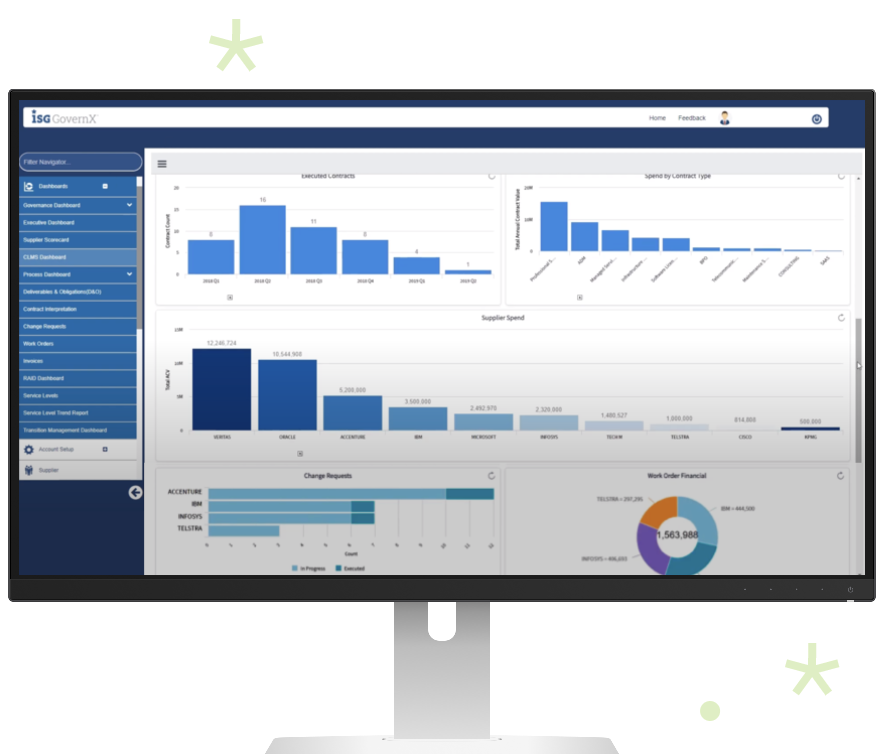
ISG’s Supplier & Contract Management solutions are supported by GovernX, our world-class, end-to-end managed service and lifecycle management SaaS platform. GovernX provides our analysts and your teams with the real-time, AI-powered data necessary to manage complex contract portfolios effectively, and get the greatest value out of your supplier relationships.
ISG is a leader in proprietary research, advisory consulting and executive event services focused on market trends and disruptive technologies.
Get the insight and guidance you need to accelerate growth and create more value.
Learn MoreIn the current business landscape, enterprises continue to face disruptions such as tariffs, wars, political unrest and climate shocks. Hence, it has become mandatory for supply chain leaders to look beyond temporary fixes and pursue larger transformations to gain a competitive advantage. A siloed or process specific uplift provides short-term relief, but building future-ready, connected, intelligent and sustainable supply chains requires a comprehensive revamp, driven by technologies such as AI, analytics, supplier relationship management (SRM) and automation. This year’s assessment highlights a major shift in chief supplier officers’ approach, focusing more on enhancing process optimization and operational efficiency than merely targeting cost savings to stay ahead of the competition.
Collaborative Supply Chain Forecasting (CSCF) is a business discipline involving multiple supply chain stakeholders, including suppliers, distributors and sellers, that is aimed at producing a more accurate forecast of future demand and supply. Participants share supply and demand data, forecasts, assumptions and insights to improve visibility, reduce inefficiencies and attenuate supply-demand mismatches. ISG asserts that by 2028, one-third of larger enterprises will have adopted some form of CSCF to reduce costs and improve customer service and supplier relations. However, there are serious challenges to widespread adoption.
Supply chains are being reimagined with intelligent orchestration, adaptability and resilience. Globally, they are under mounting pressure due to complexities driven by multitier supplier ecosystems, distributed manufacturing setups, hyperlocalized demand patterns and operational dependencies arising from geopolitical shifts. Supply chain companies
are increasingly recognizing that data and AI are essential for transforming supply chains, enabling responsive and even preemptive actions to minimize disruptions and their economic impact.
Use data to assess your supplier delivery against regulations and monitor customer-specific requirements. Complexity and regulatory scrutiny of third-party relationships are on the rise. Get a comprehensive and data-driven way to control risk throughout the life of the relationship.
Value leakage happens when a business loses potential profit or cost advantages somewhere between its operations and the customer. This means a deal or project doesn't deliver the full value it promised. Failure to achieve promised value often happens when established processes aren’t followed, performance management is poor, projects shift unexpectedly or opportunities for improvement are missed.
Keep suppliers on track by monitoring their performance, making sure they fulfill their contractual obligations and maintaining clear communication. Continuously track results, identify and address issues, figure out their root causes and update agreements as circumstances evolve.
SRM focuses on building lasting, collaborative partnerships with suppliers to maximize value. CLM manages contracts from start to finish – including creation, negotiation, approval, obligation tracking, amendments, renewals and eventual archiving.
Build strong partnerships, monitor their performance and proactively solve issues. Continually refine the collaboration process. Foster honest and transparent communication with all stakeholders, maintain detailed documentation and always ensure your actions align with your objectives and relevant regulations.
Managing third-party risk means identifying and reducing the potential problems that come with working with external companies or partners. TPRM helps you manage risks from vendors and partners from the moment you start working with them through the entire business relationship. It safeguards the organization by proactively identifying, monitoring and managing potential issues like financial loss, operational disruption, legal challenges, security threats and reputational damage.
