Reinventing Bank Branches of the Future
While digital banking dominates, customers still value in-person services for complex financial needs. What’s the future of bank branches?
Industries
Get closer to customers, drive operational efficiency and enable employees.
Let us help you find and implement the right technologies to improve your customer experience, optimize data and transform your business model.
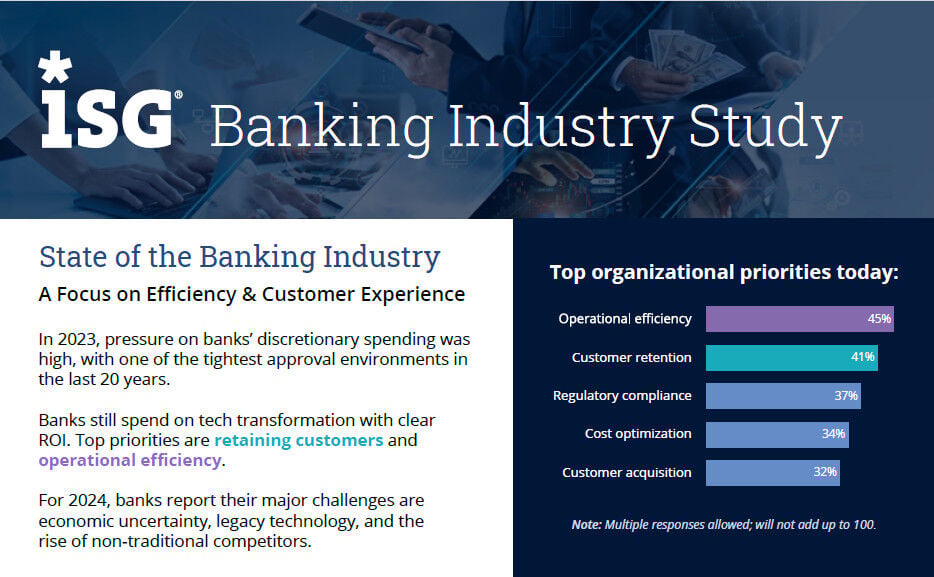
ISG's recent study shows the banking industry's top priorities are operational efficiency and customer experience.
Will most people go back to purely in-person banking? No. But the demise of bank branches is greatly exaggerated - a recent Celent report says that 77% of customers want to be face-to-face for substantive discussions about their finances.
Read ISG’s whitepaper to learn how to reimagine your #branchstrategy for the future of banking.
AI investment is accelerating, but results remain uneven. Only one in four initiatives is meeting revenue impact expectations, at an average spend of $1.3M per use case. Enterprises are no longer asking whether AI works. They are being asked to prove that it pays.
We help you identify where AI agents deliver the most value, restructure workflows around them and build the accountability models that keep autonomous execution auditable. The enterprises that win won't be the ones that reacted. They'll be the ones that designed for it first.
We give enterprises transparent, benchmarkable pricing models that tag each resource unit with the autonomy level used to deliver it. As AI capability advances, your pricing keeps pace. Both buyers and providers can quantify what that progress is worth.
We bring analysis of more than $2.6 billion in tracked AI spend to every sourcing decision. Procurement, technology and finance leaders get the independent intelligence to rationalize vendor portfolios and hold providers accountable to measurable outcomes.
We embed controls at the point of data creation, define accountability for autonomous actions and build adaptive frameworks that keep pace with AI without impeding it. Enterprises that get this right don't just manage risk. They build the trust that lets them scale faster.
We ground strategy in research across 2,400 enterprise use cases, aligning investment to where impact is proven and designing the data, talent and governance foundations that move AI from pilots into the workflows that drive commercial results.
We benchmark your AI readiness against peers across 75 countries, identify the dimensions holding you back and give you a personalized roadmap to close the gap.
AI investment is shifting decisively toward revenue-generating functions. CRM automation, sales enablement and forecasting have replaced chatbots and IT productivity tools as the leading use case priorities, reflecting enterprise recognition that productivity gains alone do not satisfy board-level scrutiny. At the same time, use cases in production have doubled since 2024, and the portfolio is diversifying rapidly, with over 300 distinct function and industry-specific use cases now in active deployment.
ISG research across 2,400 enterprise use cases shows that the strongest AI returns are currently concentrated in compliance, risk management and quality control, not in the growth and cost outcomes most enterprises originally set out to achieve
The gap between where enterprises are investing and where AI is actually delivering is the defining commercial tension of 2025. Organizations that close it by targeting functions with structured, revenue-attributable data and clear ROI measures will establish performance benchmarks that compress the window for competitors still cycling through pilots. The standard is being set now.
ISG is a leader in proprietary research, advisory consulting and executive event services focused on market trends and disruptive technologies.
Get the insight and guidance you need to accelerate growth and create more value.
Learn MoreThere's a saying among military historians that amateurs debate strategy while professionals talk about logistics. In a similar vein, those rooted deeply in the workings of information technology (IT) pay close attention to data because it is fundamental to the proficiency and effectiveness of any IT system. Visionaries speak of data being the oil or gold of the information economy; practitioners recognize that it is the structural steel. Potentially, one of the unexpected benefits of the artificial intelligence (AI) revolution may be the ability and willingness to address the decades-long problems of data quality and availability. More powerful data management tools and the motivation to invest in and use them are likely to significantly reduce (but by no means eliminate) these issues. This, as much as the power of AI—in all its forms—to streamline and even automate business process execution, will lead to a step-function increase in the productivity of the Office of Finance.
The Finance and Accounting Outsourcing (FAO) market in 2025 is undergoing one of the most significant shifts it has seen in the past decade. In contrast to 2024, when discussions surrounding AI, generative AI (GenAI) and advanced analytics primarily focused on pilots and early-stage PoCs, the current landscape is defined by operationalized innovation. Providers have transitioned from experimentation to deployment, embedding these technologies into live delivery environments and demonstrating measurable business impact.
The six costliest words in managing a finance department are, “We’ve always done it this way.” The record-to-report (R2R) cycle describes the process of finalizing and summarizing the financial activities of a business for a specific accounting period—typically a month, quarter or fiscal year. It is important to note that R2R exclusively covers the activities between recording (keeping the books) and reporting (publishing financial statements and management accounts). It involves completing various tasks to ensure that all revenue, expense and other financial transactions are properly recorded, accounts are balanced and accurate financial statements can be prepared.
Every expectation of the contact center got slammed by the pandemic– from staffing, security, infrastructure, training, shoring locations, providers/captives, channels, performance to workforce management. ISG’s Sandra Williams discusses how banking contact centers became prime examples of Darwin’s theory that only the one most responsive to change will survive.
Automation can drive efficiency, resiliency and flexibility across the enterprise. ISG’s Jay Woldar explores how evolving technology from business process automation to robotic process automation to cognitive can transform applications and maximize return on investment.